7 Algorithm Patterns Every Developer Should Master for Interviews
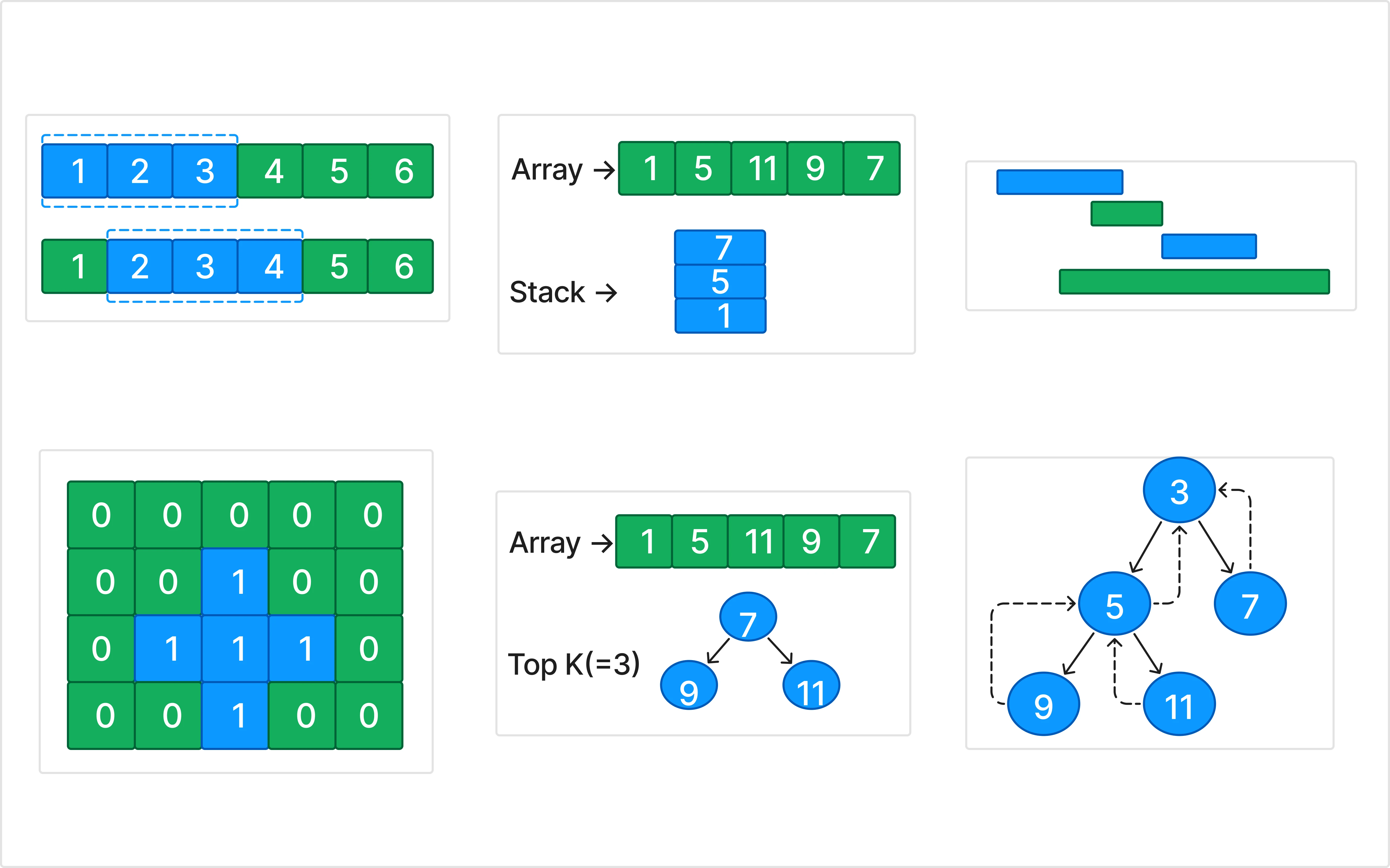
Stop solving random LeetCode questions. Focus on these 7 algorithm patterns that show up in most dev interviews.
Introduction
Tech interviews are tough — but not random. Most algorithm problems fall under a handful of core patterns. If you can recognize these, you can solve almost anything on LeetCode, HackerRank, or Codeforces.
Here are the 7 most popular algorithm problem patterns that show up across frontend, backend, and full-stack developer interviews.
🧩 1. Sliding Window
Used for subarray or substring problems — typically involving sums, lengths, or frequencies.
📌 Common question: Find the longest substring without repeating characters
When to use: Fixed-size or dynamic size window problems involving arrays or strings.
🔁 2. Two Pointers
Involves iterating from both ends of a structure (like arrays or strings) and moving inward or outward.
📌 Common question: Container with most water
When to use: Sorted arrays, palindromes, merging, reversing in-place.
🧠 3. Fast and Slow Pointers
A variation of two pointers used to detect cycles or middle elements.
📌 Common question: Linked List Cycle
When to use: Linked lists, circular arrays, Floyd’s cycle detection.
🔁 4. Depth-First Search (DFS)
Recursively explores all paths — often used in trees and graphs.
📌 Common question: Number of Islands
When to use: Tree traversal, graph connectivity, backtracking.
🌊 5. Breadth-First Search (BFS)
Explores level-by-level — useful for shortest path and spreading processes.
📌 Common question: Minimum depth of binary tree
When to use: Shortest paths, social networks, grid problems.
📊 6. Hash Map + Set
Optimizes brute-force solutions by using fast lookup structures.
📌 Common question: Two Sum, Group Anagrams
When to use: Lookups, duplicates, frequency counts.
📐 7. Binary Search
Cuts search space in half — not just for numbers, also for optimization problems.
📌 Common question: Find minimum in rotated sorted array
When to use: Sorted arrays, partitioning, search-based optimization.
Conclusion
Don’t memorize 500 LeetCode problems. Master these 7 patterns and you’ll start to see the structure behind almost every interview question.
🎯 Tip: Try solving 3–5 problems for each pattern to lock in the concepts.
What’s Next?
- Want a curated list of sliding window problems in JavaScript?
- Need mock interview prep focused on Laravel/JS full-stack roles?
Check out the blog for focused guides and coding patterns:
🔗 https://mostefa-boudjema.vercel.app/blog
Related Posts

Top Web Development Interview Questions (And How to Answer Them Right)
Top Remote Job Platforms for Full-Stack Developers (International-Friendly)

20 Core JavaScript Concepts That Will Instantly Make You a More Confident Developer
PHP 8.5: New Features Every Backend Dev Should Know

Advanced React: Optimizing Performance and Advanced Patterns